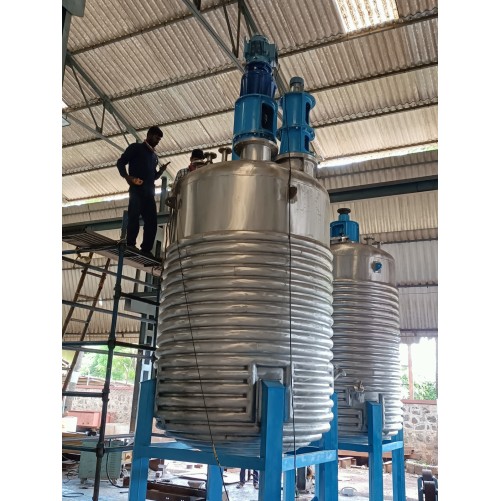
What Is a Jacket Reactor and How Does It Work?
A Jacket Reactor is an industrial processing vessel used for carrying out chemical reactions, mixing, heating, and cooling operations under controlled temperature conditions. It consists of an inner cylindrical vessel and an outer jacket that surrounds the main processing chamber. The space between the vessel and the jacket allows heating or cooling media to circulate.
Common heating media include steam, hot water, and thermal oil, while cooling media may include chilled water or other suitable cooling fluids. Heat is transferred through the vessel wall without allowing the heating or cooling medium to mix directly with the product.
Jacket reactors are widely used in chemical, pharmaceutical, food processing, cosmetic, and specialty chemical industries. They can be manufactured in different capacities, materials, and configurations according to the required operating pressure, temperature, and processing conditions. At Swamiraj Engineering, jacketed and limpeted vessel designs can be developed according to application requirements, technical specifications, and customer drawings.
Working Process of a Jacket Reactor
A jacket reactor operates through a controlled sequence of material loading, heating or cooling, mixing, reaction processing, and product discharge.
- Raw Material Charging: The required raw materials are introduced into the reactor vessel through designated charging openings. The quantity and sequence of addition depend on the production process.
- Heating or Cooling Medium Circulation: Steam, thermal oil, hot water, or chilled water is circulated through the external jacket to transfer heat to or remove heat from the material inside the vessel.
- Temperature Regulation: Temperature sensors and control instruments monitor the internal temperature, and the heating or cooling supply is adjusted to maintain the required process conditions.
- Agitation and Mixing: An agitator assembly driven by a suitable motor and gearbox rotates inside the reactor, maintaining uniform mixing and improving heat distribution.
- Chemical Reaction: The raw materials undergo the required chemical or physical reaction under controlled temperature, pressure, and mixing conditions.
- Process Monitoring: Operators monitor temperature, pressure, agitation speed, and processing time to maintain operational consistency.
- Product Discharge: Once the cycle is complete, the finished material is discharged through a suitable outlet arrangement.
- Cleaning and Maintenance: The reactor is cleaned and inspected according to process requirements to maintain performance and prepare it for the next production cycle.
Types of Jacket Reactors
Different jacket reactor designs are used depending on heating and cooling requirements, vessel construction, process material, and operating conditions.
- Single Jacket Reactor: An external jacket surrounds the main vessel, and heating or cooling media circulates through it to regulate the internal temperature. Commonly used in general chemical processing.
- Double Jacket Reactor: Uses an additional jacket arrangement or separate circulation zones to support specific thermal requirements, suitable for customized heating and cooling configurations.
- Dimple Jacket Reactor: Features a dimpled outer surface that creates circulation channels for heating or cooling media, providing an effective heat transfer arrangement.
- Half Pipe Coil Jacket Reactor: Half-pipe coils are welded around the vessel's external surface, giving a defined flow path for heating or cooling fluids and suiting specific pressure and heat transfer requirements.
- Full Jacket Reactor: An outer jacket covers the designated surface of the main vessel, supporting controlled heating and cooling over the covered area.
- Stainless Steel Jacket Reactor: Made from SS 304L or SS 316L, suitable for applications requiring corrosion resistance, cleanability, and durability.
- Limpet Coil Jacket Reactor: Uses an external limpet coil arrangement for circulating heating or cooling media, commonly selected where efficient thermal management is required.
- Pressure Jacket Reactor: Designed for specified internal and external pressure conditions, used where controlled pressure and temperature are essential.
- Vacuum Jacket Reactor: Configured for vacuum operating conditions, used in solvent removal, evaporation, and specialized chemical processing.
- Agitated Jacket Reactor: Incorporates an internal agitator to improve mixing and material circulation, suitable for liquids, viscous materials, and formulations requiring uniform blending.
Technical Specifications of Jacket Reactors
Jacket reactors are engineered according to specific industrial process requirements. Important technical parameters are given in the table below.
| Classification |
Parameter |
Key Technical Feature |
Selection Basis |
| Design & Construction |
Capacity |
Available in different capacities. |
Production volume and process requirements. |
| Material of Construction |
AISI 304L, AISI 316L, Duplex Steel 2205, SA516 Grade 70. |
Application and chemical compatibility. |
| Design Standards |
ASME Section VIII Division 1 and EN 13445. |
As specified for the project. |
| Accessories and Fittings |
Manholes, nozzles, temperature sensors, pressure gauges, safety valves, discharge connections. |
Depending on the application. |
| Heat Transfer |
Jacket Configuration |
Single jacket, dimple jacket, full jacket, half-pipe coil. |
Heat transfer requirements. |
| Heating Medium |
Steam, hot water, and thermal oil. |
Process requirements. |
| Cooling Medium |
Chilled water and other suitable cooling fluids. |
Process temperature requirements. |
| Operating Conditions |
Operating Temperature |
Designed for the required process temperature. |
Selected heating or cooling medium. |
| Operating Pressure |
Vessel and jacket pressure ratings. |
Design calculations and operating requirements. |
| Mixing |
Agitator Arrangement |
Anchor, turbine, propeller, and other configurations. |
Material viscosity and mixing requirements. |
Note: Final specifications, dimensions, capacity, pressure, and temperature ratings are customized according to approved engineering drawings and project requirements.
Applications of Jacket Reactors
Jacket reactors are widely used across industries that require controlled heating, cooling, chemical reactions, and uniform mixing.
- Chemical Industry: Chemical synthesis, blending, heating, and processing of industrial chemicals, solvents, and specialty chemical formulations.
- Pharmaceutical Industry: Processing intermediates, formulations, and chemical compounds under controlled conditions.
- Food Processing Industry: Heating, mixing, and processing food ingredients, syrups, sauces, and other compatible materials.
- Petrochemical Industry: Selected petrochemical operations requiring controlled temperature and pressure.
- Distillery Industry: Compatible processing operations involving heating, mixing, and preparation of industrial process materials.
- Cosmetic Industry: Manufacturing creams, lotions, shampoos, gels, and other products requiring controlled mixing and heating.
- Paint and Coating Industry: Processing paints, resins, coatings, and other industrial formulations.
- Resin Manufacturing: Resin production and polymer processing that require controlled reaction temperatures.
- Adhesive Manufacturing: Mixing and processing industrial adhesives, bonding compounds, and specialty formulations.
- Specialty Chemical Manufacturing: Production of specialty chemicals, additives, emulsions, and customized chemical products.
Why Choose Swamiraj Engineering as Jacket Reactor Manufacturers in India?
- 20 Years of Industry Experience: Two decades in industrial process equipment design and manufacturing help us understand different industrial requirements.
- Advanced Design and Engineering: Equipment designed according to applicable engineering codes, project specifications, and operating conditions.
- Quality Material Selection: AISI 304L, AISI 316L, Duplex Steel 2205, and SA516 Grade 70 chosen per application.
- Customized Manufacturing: Built to customer drawings, technical specifications, capacity requirements, and applications.
- Multiple Industrial Solutions: Chemical reactors, pressure vessels, jacketed vessels, limpeted vessels, agitators, mixers, dryers, heat exchangers, and storage tanks.
- Quality and Safety Focus: Emphasis on fabrication quality, material traceability, inspection, and compliance with applicable engineering and design requirements.
- International and Domestic Experience: Customers in India and international markets, including the USA, UK, Brazil, Vietnam, and Tanzania.
Swamiraj Engineering is committed to providing dependable industrial process equipment through engineering expertise, customized manufacturing, and quality-focused fabrication practices. Contact us to discuss your jacket reactor requirements and get suitable equipment solutions for your industry.
FAQ's
1. What is a Jacket Reactor used for?
A jacket reactor is used for carrying out chemical reactions, heating, cooling, and mixing operations under controlled temperature conditions. It is commonly used in chemical, pharmaceutical, food processing, cosmetic, and specialty chemical industries.
2. What materials are used in jacket reactor manufacturing?
Jacket reactors can be manufactured using stainless steel grades such as SS 304L and SS 316L, Duplex Steel 2205, carbon steel, and other suitable materials depending on chemical compatibility and operating conditions.
3. What is the difference between a jacket reactor and a limpet coil reactor?
A jacket reactor generally uses an external jacket surrounding the vessel, whereas a limpet coil reactor uses a half-pipe coil welded around the vessel's external surface. Both arrangements are used for heating and cooling, but their construction and heat transfer characteristics differ.
4. Which heating and cooling media are used in jacket reactors?
Common heating media include steam, hot water, and thermal oil. Cooling media generally include chilled water and other suitable cooling fluids, depending on the process temperature requirements.
5. Can jacket reactors be customized according to industrial requirements?
Yes. Jacket reactors can be customized according to vessel capacity, material of construction, pressure rating, operating temperature, jacket arrangement, agitator design, and other technical requirements.
6. Which industries use jacket reactors?
Jacket reactors are widely used in chemical, pharmaceutical, petroleum, food processing, distillery, cosmetic, paint, resin, and specialty chemical industries.
7. What is the function of an agitator in a jacket reactor?
An agitator helps mix the materials inside the reactor, maintain uniform material distribution, and improve heat transfer by promoting material circulation.
8. Which standards are followed in jacket reactor manufacturing?
Depending on the equipment design and project requirements, jacket reactors can be designed according to applicable standards such as ASME Section VIII Division 1 and EN 13445.
9. How do I select the right jacket reactor?
Selection depends on processing capacity, material compatibility, operating pressure, temperature range, heating and cooling requirements, agitator configuration, and applicable safety standards.
10. Why choose Swamiraj Engineering for jacket reactors?
Swamiraj Engineering offers process equipment design and manufacturing expertise, customized fabrication solutions, suitable material selection, and quality-focused engineering for diverse industrial applications.