Swamiraj Engineering is prominent noodling system manufacturers, suppliers, exporters in India is a vital tool designed to suit the needs of the industries that require perfection and purity especially in the dewatering of chemicals and pigments.
This system is designed and fabricated to conform to strict international standards such as ASME and PED and ensures a high-density noodle which means that downstream drying is enhanced dramatically and the end product is uniform.
Our hard working machines are designed to perform in harsh conditions across the globe and therefore provide smooth operation bringing operational excellence and integrity of products.
What is Noodling System?
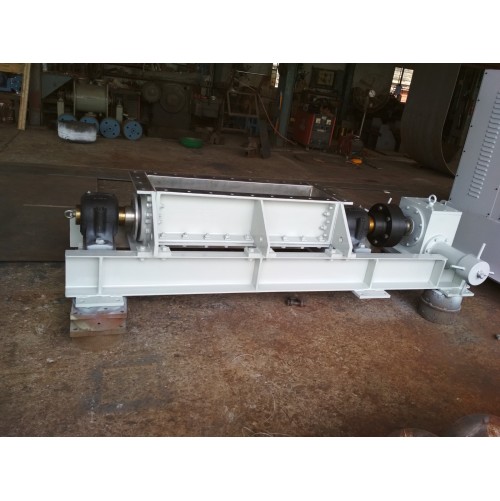
A Noodler System or Noodler, is a special extrusion machine that is utilized to extrude wet paste-like products or filter cakes. It presses the material into a die plate turning the loose bulk into homogeneous spaghetti like strands known as noodles. The reason why this process is important is that it greatly prepares materials especially the pigments and specialty chemicals to be dried in the most efficient and uniform way.
Working Principle of Noodling System
The Pigment Noodle Extruder Machine is used to make Noodles from the wet cake received from filter press through the belt conveyor. The working principle of noodle extruder is wet cake getting pressed at a very high pressure in between oscillating shaft & extruder Plate, resulting in formation of noodles from bottom of extruder plate. The oscillating shaft oscillates to & fro on extruder plate powered by Hydraulic Power pack to develop high pressure.
The out Put Noodles are collected in Tray kept below the noodler. These Trays are manually transferred to Tray dryer. The volume of Tray is about 10 Liters. Two trays are placed below the Noodler
The pigment noodle extruders are available in varying capacities from 500 kgs/Hr to 1000Kgs/Hr of Wet Cake Noodles and are available in SS304 Grade of material.
Technical Specifications of Noodling System
We've added below a specialized table of Noodling System in India that provides further technical specification information.
| Model No |
Noodler Machine Length |
Size of Noodles |
Hydraulic Power Pack Motor HP |
| SENM1000 |
1000 mm |
8 mm |
12.5 |
| SENM1600 |
1600 mm |
8 mm |
15 |
| SENM2000 |
2000 mm |
8 mm |
20 |
Benefits/Features of Noodling System
We as noodling system suppliers in India, we provided different benefits which are given below.
- Enhanced Drying Efficiency: The process brings the surface area of the material to a huge size in comparison to a solid cake. This implies that moisture is liberated at a much higher rate which is more uniform hence shortening the drying cycle.
- Improved Material Handling: The noodle strands obtained are semi-solid and not as sticky as wet paste. Noodling system manufacturers in India allows them to be transported, conveyed and fed downstream without clumping or dusting.
- Uniform Product Quality: It helps provide that all the material that is extruded is uniform in diameter and length. Such consistency is necessary to have high quality control and consistency of the final products in batch-to-batch.
- Continuous Operation: The system is aimed towards feeding wet material in the highest capacity, 24 hours a day. Noodling system exporters in India enables easy integration to large scale production lines to maximize throughput and total plant productivity.
Key Characteristics of Noodling System
- Reduction in Drying Time for Pigment up to 8 to 10 Hours less than the conventional Tray Drying Process.
- Lesser energy Consumption due to short Drying time required.
- Increased Drying capacity due to faster drying time and increase in Productivity.
- Less manpower involved for filling the tray and handling the cake.
- As after Noodling scraping of trays not required, thus saving the energy and Manpower.
- Safe and Hygienic method of Filling the Noodles and Tray.
Applications of Noodling System
We serve as notable noodling system exporters in India; it is applicable in different sites which are given below.
- Pigment Manufacturing: This is the preparation of wet filter cakes of organic and inorganic pigments (e.g., dyestuffs, iron oxides) to be dried on a tray or belt.
- Specialty Chemicals: Conversion of premium chemical intermediates and catalysts into easy-to-manage, dry forms.
- Dye Intermediates: Dye intermediates are utilized in the dye industry in the production of wet dye pastes which are then shaped into strands and then subjected to final thermal processing in noodling system manufacturers in India.
- Pharmaceutical Powders: Wet granule formulations are extruded and the particle size is regulated followed by final drying and tablet production of Noodling Machine.
Why Select Us for Noodling System?
- International Standard Production: We develop and produce Noodling Systems in accordance with the main international standards, which will provide the world quality and simple export.
- Tailored Engineering: We will provide you with a system that is specifically designed to meet your desired material viscosity, volume and desired noodle size in order to provide the best performance.
- International Experience in Proven Equipment: Our equipment is reliable and tested by the clients in different parts of the world (including the USA, the UK and Brazil) and has a proven export background.
Swamiraj Engineering is leading noodling system manufacturers, suppliers, exporters in India. Your material is instantly transformed into uniformly shaped strands of fine size, by our Noodling System. Maximum speed to dry and ensure a high standard of product in each batch. Select our powerful, internationally compliant machine and feel the final change in efficiency our slow paste to an efficient fast-track process. Keep your production as high as possible, keep your energy consumption as low as possible. Achieve the competitive advantage now!
Swamiraj Engineering with its experience over 20 years in pigment noodling system has designed and developed cost effective solution for Wet Cake Noodling and drying. The system saves valuable Energy & Time for drying the pigment, thereby reducing the overall cost for drying.